

“Nolite te bastardes carborundorum”
Margaret Atwood, The Handmaid’s Tale
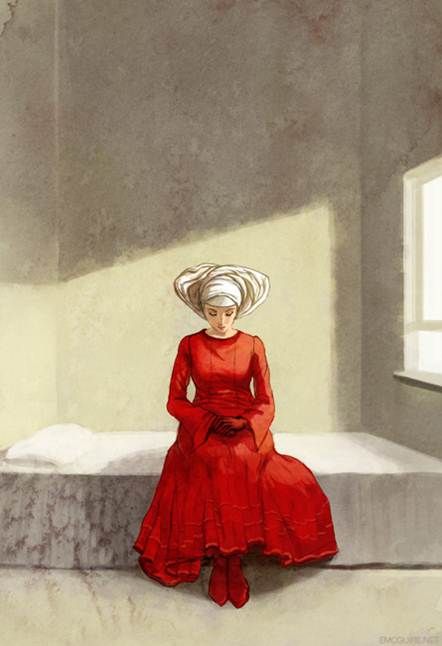
The book, The Handmaid’s Tale, is written in the first person perspective of Offred. This story is told as a reflective journal-type piece. In the “Historical Notes” section of the novel, the focus shifts to presumably future researchers discussing the implications and validity of Offred’s story and narration. The views being represented in this story are those of the group of individuals who are being stripped of their autonomy and have no say in the society that they’re being forced into. These individuals are specifically women. In the futuristic Gileadean era that this book takes place in, women are no longer allowed to be independent from men and are forced into lifestyles that are determined by their previous sexual, romantic, and religious statuses. Offred explains that women have been “divided into functions” (Atwood 24). Offred is part of the sect of women known as the ‘handmaids’. The ‘handmaids’ are forced to subject themselves to being surrogates for older couples of high status in society. By blatantly revealing the horrors of a totalitarian, suppressive nation that targets the independence of a distinct group of people, the author forces the reader to reflect on historical and present situations of removal of personal agency.
The setting of The Handmaid’s Tale is of a dystopian United States. Offred explains throughout the story that the United States has descended into a totalitarian system with a heightened and perverse moral background that stems from Christian beliefs. The author’s use of flashbacks to America post-dystopia, and the descent into the society that the book takes place in, gives the reader a clear understanding of the setting. An example of this being, “It was after the catastrophe, when they shot the president and machine gunned the Congress and the army declared a state of emergency. They blamed it on the Islamic fanatics, at the time…that was when they suspended the Constitution” (Atwood 174). Offred jumps to another flashback in the same chapter that explains the increased removal of independence towards women. In the flashback, Offred tells of how the government began blocking women from their bank accounts and of how women were being fired because, “it’s the law” (Atwood 176). This was the beginning of the government’s control over women’s lives and the reduction of their capabilities, forcing them to be dependent on men.
The primary characters of The Handmaid’s Tale include Offred, Selena Joy, the Commander, and Moira. At the beginning of the book, Offred was extremely passive outwardly towards the world, but her inner thoughts were those of rebellion towards the life and society she was forced into. This can be observed during Offred’s outing to the shop in chapter four. Offred displays the outward appearance of a good, devoted, brainwashed handmaid. However, when Offred meets the guards outside of the city center that let her in, she acts with subtle rebellion by walking in a seductive manner. At first she feels ashamed but then she states that, “I find that I’m not ashamed after all. I enjoy the power; power of a dogbone, passive but there” (Atwood 22). Offred also dwells heavily on her past life, remembering her husband and her daughter and the time before. Almost obsessing and wishing that she could go back. As the story progresses, we see Offred take more and more risks and begin to fight against the system in grander gestures. By the end of the novel, Offred has abandoned almost all caution and actively pursues ‘illegal’ actions with Nick. She takes on the naive notion that she’ll be both happy and safe in her situation of criminal acts; “The fact is that I no longer want to leave, escape, cross the border to freedom. I want to be here, with Nick, where I can get at him” (Atwood 271). Offred also has let go of her past and no longer obsesses over the pre-dystopian America. She comes to the realization that time has past, society has changed, and the family that she was clinging to was beyond saving.
Serena Joy’s character is mainly revealed through the level of hate that Offred feels toward her throughout the book. Serena Joy is the Wife of the Commander, and fundamentally Offred’s service demeans Serena’s position as a well-rounded wife. In the beginning, Serena Joy and Offred share a sense of mutual hate towards one another; “I could see already that I wouldn’t have liked her, nor she me” (Atwood 16). Towards the end of the book, however, Serena and Offred put aside their hate to contrive a plan to get Offred pregnant, a goal that both women desire; “…This idea hangs between us, almost visible, almost palpable: heavy, formless, dark; collusion of a sort, betrayal of a sort. She does want that baby” (Atwood 205). While Serena’s consideration towards Offred changes throughout the story, her grasp and display of power is seen consistently; “She didn’t step aside to let me in, she just stood there in the doorway, blocking the entrance. She wanted me to feel that I could not come into the house unless she said so” (Atwood 13).
The Commander’s character is considerably developed as the story unfolds. The reader at first knows little to nothing about him. His description is very flat and lacking of dimension. Once Offred is offered the opportunity to spend evenings with the Commander, the reader is given a greater understanding of his character. Through the meetings, the reader learns that the Commander is lacking in his marital relationship and likes to flaunt his power by engaging in illegal activities with his handmaids. This behavior builds to a peak when he invites Offred to Jezebel’s, a government run ‘underground’ club for men with higher societal status. This is the catalyst at the end of the novel when Serena finds out and decides to punish Offred for her actions. At this moment in the book, all of the favor that the Commander felt towards Offred disappears and he resigns himself to his previous faded description that is told at the beginning of the novel.
Moira is idolized by Offred throughout the novel. Her character is relatively static throughout the book. She serves as Offred’s beacon of hope and resistance against the system; “I don’t want her to be like me. Give in, go along, save her skin. That is what it comes down to. I want gallantry from her, swashbuckling, heroism, single-handed combat. Something I lack” (Atwood 249). Her reckless, nihilist behavior stays strong throughout the story to the point that Offred is worried about her remaining friend; “Her voice is frightening me now, because what I hear in her voice is indifference, a lack of volition” (Atwood 249). Towards the end, Offred ends up like Moira; indifferent and lacking volition.
The secondary characters of The Handmaid’s Tale include Nick, Cora, Rita, Offred’s daughter, mother, and husband. Nick is a Guard stationed at the Commander’s house and is used as a pawn for both the Commander and Serena Joy. Offred also develops feelings for him towards the end of the book and some speculate that he organized a rescue mission for her in the last scene. Cora is a ‘Martha’ and generally tends to household chores and would help in the wellbeing of a baby. She and Offred have a rocky, uncertain relationship. Rita is the house’s cook and generally disapproves of Offred. Offred’s daughter, mother, and husband are referenced extensively throughout the novel but Offred never meets them face to face after societal shift.
The overall tone of this piece could be described as grim, detached, but also intense. An example of the tone of grimness can be found throughout the book, but especially when Offred and Ofglen first stop to look at the criminals hanging on The Wall. Offred describes the bags over the criminals as such: “It makes them look like dolls…like scarecrows, which in a way is what they are, since they are meant to scare…on one bag there’s blood, which has seeped through the white cloth, where the mouth must have been. It makes another mouth, a small red one, like the mouths painted with thick brushes by kindergarten children A child’s idea of a smile. This smile of blood is what fixes the attention, finally” (Atwood 32). The detached tone of the piece is relevant in how we view the society built in this book and also in how we perceive Offred, an example of this being when we first see Offred performing her true service to the Commander and Serena by offering herself as a vessel for life; “One detaches oneself. One describes” (Atwood 93). Lastly, while the tone of this book is often detached in tone, sections reveal and intensity of emotion in Offred. This can be observed when Offred tells of her former life, of her attempted escape from the country, and when she thinks about her husband and child; “Time has not stood still. It has washed over me, washed me away, as if I’m nothing more than a woman of sand, left by a careless child too near the water. I have been obliterated for her. I am only a shadow now…a shadow of a shadow, as dead mothers become. You can see it in her eyes; I’m not there” (Atwood 228).

Imagery is abundant in The Handmaid’s Tale. One instance of the use of imagery is when Offred describes the Japanese female tourists; “They look around, bright-eyed, cocking their heads to one side like a robin, their very cheerfulness aggressive…The skirts reach just below the knee and the legs come out from beneath them, nearly naked in their thin stockings, blatant, the high-heeled shoes with their straps attached to the feet like delicate instruments of torture. The women teeter on their spiked feet as if on stilts…Their heads are uncovered and their hair too is exposed, in all its darkness and sexuality. They wear lipstick, red, outlining the damp cavities of their mouths, like scrawls on a washroom wall, of the time before” (Atwood 28). This imagery gives illustrates the women as flamboyant, promiscuous, and vulgar, despite the fact that they are wearing perfectly decent apparel, by modern societal standards. Another time imagery is used is when Offred describes how she felt about her body before and during this new role she was forced into; “I used to think of my body as an instrument, of pleasure, or a means of transportation, or an implement for the accomplishment of my will. I could use it to run, push buttons of one sort or another, make things happen. There were limits, but my body was nevertheless lithe, single, solid, one with me” (Atwood 73). This next quote focuses on Offred’s perspective once she is a handmaid, “Now the flash arranges itself differently. I’m a cloud, congealed around a central object, the shape of a pear, which is hard and more real than I am and glows red within its translucent wrapping. Inside it is a space, huge as the sky at night and dark and curved like that, though black-red rather than black. Pinpoints of light swell, sparkle, burst and shrivel within it, countless as stars. Every month there is a moon, gigantic, round, heavy, and omen. It transits, pauses, continues on and passes out of sight, and I see despair coming towards me like famine. To feel that empty, again, again. I listen to my heart, wave upon wave, salty and red, continuing on and on, marking time” (Atwood 73-74). This imagery allows the reader to fully understand how Offred’s perspective has changed towards her body. She used to feel that she controlled it and now she feels that her body is simply a container for something of more value. Finally, imagery is used to capture a beautiful snapshot of life in the garden outside of the Commander’s home; “Then we had irises, rising beautiful and cool on their tall stalks, like blown glass, like pastel water momentarily frozen in a splash, light blue, light mauve, and the darker ones, velvet and purple, black cat’s ears in the sun, indigo shadow, and the bleeding hearts, so female in shape it was a surprise they’d not long since been rooted out. There is something subversive about this garden of Serena’s, a sense of buried things bursting upwards, wordlessly, into the light, as if to point, to say: Whatever is silenced will clamor to be heard, though silently. A Tennyson garden, heavy with scent, languid; the return of the word swoon. Light pours down from the sun, true, but heat rises, from the flowers themselves, you can feel it: like holding your hand an inch above an arm, a shoulder. It breathes, in warmth, breathing itself in. To walk through it in these days, of peonies, of pinks and carnations, makes my head swim” (Atwood 153). This illustration allows for the reader to take a moment away from the struggle and the grim reality of the world of this story, and to remember that there is still pockets of goodness. As Offred notes towards the end of the novel, “I’ve tried to put some of the good things in as well. Flowers, for instance, because where would we be without them?” (Atwood 267).
The author uses euphemisms, flashbacks, and verbal irony to capture the reader’s attention throughout the story. A tirade of euphemisms are used when Offred is talking about intercourse and specifically male genitalia; “To have them putting him on, trying him on, trying him out, while he himself puts them on, like a sock over a foot, onto the stub of himself, his extra, sensitive thumb, his tentacle, his delicate, stalked slug’s eye, which extrudes, expands, winces, and shrivels back into himself when touched wrongly, grows big again, bulging a little at the tip, traveling forward as if along a leaf, into them, avid for vision. To achieve vision this way, this journey into a darkness that is composed of women, a woman, who can see in darkness while he himself strains blindly forward” (Atwood 87-88). These euphemisms hold the reader in a state of revulsed attention, enthralled as if they were watching a car crash but couldn’t look away. Flashbacks are constant throughout the book, giving the reader a look into the world before and into Offred’s personal life. An example of when flashbacks are used is when Offred remembers her escape attempt; “It’s a Saturday morning in September, I’m wearing my shining name. The little girl who is now dead sits in the back seat, with her two best dolls, her stuffed rabbit, mangy with age and love. They are sentimental details but I can’t help that…She thought we were going on a picnic, and in fact there was a picnic basket in the backseat, beside her, with real food in it, hard-boiled eggs, thermos and all. We didn’t want her to know where we were really going, we didn’t want her to tell, by mistake, reveal anything, if we were stopped. We didn’t want to lay upon her the burden of truth” (Atwood 84). Lastly, the author uses verbal irony to cut a slice of humor into the story, or to heighten a sense of emotion within the reader. An example of when the author uses verbal irony in a humorous way is when the Commander is reading the Bible and everyone is gathered in the room to listen. Offred remarks, “here comes our bedtime story” (Atwood 87). This is ironic because the contents of his message are hardly reminiscent of fantasy or fairytale.
Within this dystopian world, tensions and conflicts run high. The type of conflict that is mainly focused on in The Handmaid’s Tale is man vs society. Offred is against everything that the government stands for and the actions that they are taking. The government is equally against any rebellious actions Offred or anyone else might take. A physical representation of this conflict in the book are the Eyes. The Eyes are modeled after the KGB and their presence adds tension throughout the story. An example of the tension caused by these government officials is when Offred and Ofglen observe an old man being taken by the Eyes; “I look up quickly: it’s a black van, with the white-winged eye on the side…I freeze, cold travels through me, down to my feet. There must have been microphones, they’ve heard us after all…They grab a man who is walking along, a man with a briefcase, an ordinary-looking man, slam him against the black side of the van. He’s there for a moment, splayed out against the metal as if stuck to it; then one of the Eyes moves in on him, does something sharp and brutal that doubles him over…It’s over, in seconds, and the traffic on the street resumes as if nothing has happened. What I feel is relief. That it wasn’t me” (Atwood 170). There is also a high amount of tension and conflict inside the household of Serena Joy and the Commander. This especially increases as Offred continues to visit the Commander at night. This conflict and tension can be seen during the second scene that we see the Commander and Offred trying to copulate; “If she were to find out…he wouldn’t be able to intervene, to save me; the transgressions of women in the household, whether Martha or Handmaid, are supposed to be under jurisdiction of the Wives alone. She was a malicious and vengeful woman, I knew that…the Commander could give me away so easily, by a look, by a gesture, some tiny slip that would reveal to anyone watching that there was something between us now. He almost did it the night of the Ceremony. He reached his hand up as if to touch my face…” (Atwood 162). This situation Offred has found herself in offers up new tensions and conflicts to deal with. Any suggestion that illegal activity is occurring between herself and the Commander would mean serious punishment towards Offred. Conflict in the story is also represented in the Red Center with the Aunts. The Aunts are the brainwashers and enforcers of society towards handmaids especially. We can see this conflicting nature when Offred refers back to a time that Moira had ‘offended’ the Aunts; “They took her into the room that used to be the Science Lab. It was a room where none of us ever went willingly. Afterwards, she could not walk for a week, her feet could not fit into her shoes, they were too swollen. It was the feet they’d do, for a first offense. They used steel cables, frayed at the ends. After that the hands. They didn’t care what they did to your feet or hands, even if it was permanent. Remember, said Aunt Lydia. For our purposes your feet and hands are not essential” (Atwood 91).
The Handmaid’s Tale target audience would be young adults and adults. This is evident because of its themes of politics in the sexuality. Upon reading The Handmaid’s Tale I saw no evidence of cultural misrepresentation or appropriation. This is due to the fact that the setting is in the distant future, and the focus is primarily local. There is a scene where Offred describes Japense tourists, but I don’t believe that any of the statements made were directed towards Japenese people or culture specifically. I think this culture was chosen as a realistic group that the “Republic of Gilead” would be working with in a political and economic sense. The Japense tourists were also used as a tool to illustrate the isolation of the dystopian society compared to the relative normality of the rest of the world.
The author, Margaret Atwood, began writing this novel 31 years ago while she was living in West Berlin, which was bordered by the Berlin Wall at the time. Atwood journaled her experiences during the time and fellow writer Valerie Martin told her that she was onto something big. The author’s intentions were to show how the progression of society today could lead to a society as depicted in this novel. The purpose of this story is to provide a commentary on women’s rights and the rights of oppressed individuals throughout history and even today, and to give an extreme perspective of the future. The purpose of this novel is also to talk about feminism in the political, social, and economic realms as well as in sexual liberation. This specific purpose is illustrated through the character of Offred’s mom and her resistance against the patriarchy. The author wants us as readers to reflect on our system of government and of how society dehumanizes and destroys a minority’s independence.
My overall impression of The Handmaid’s Tale is that it was a well written, deep and complex story that plays with a concept that isn’t too hard to believe could happen. I’m happy that I have read this story and I hope that many more people do too! I would also like to see how the Hulu series compares.
 The Book Nook
AMAZING!
LikeLiked by 1 person
Thank you! 🙂
LikeLike